

BLOG #6: YOU'RE FIRED…
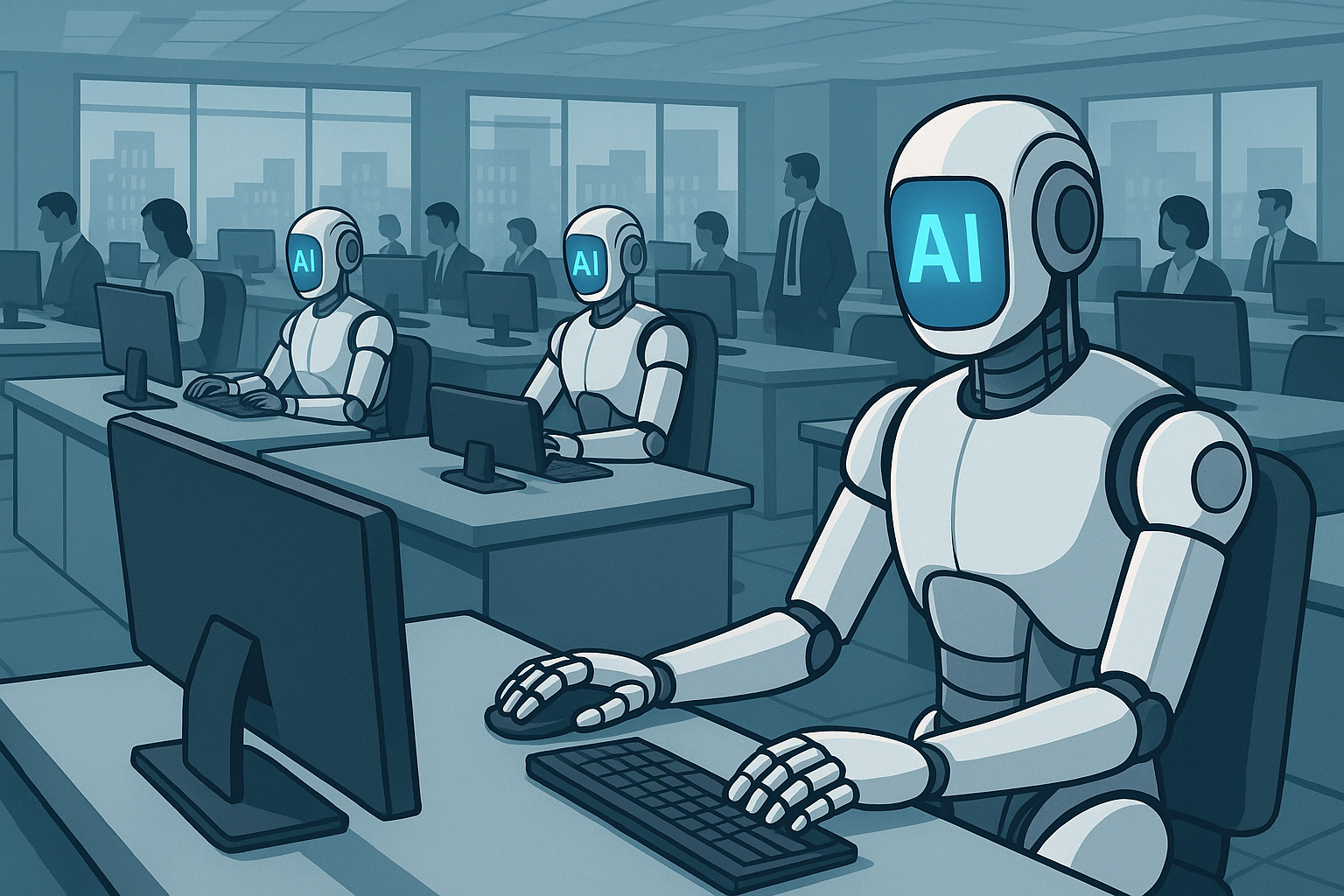
You’re Fired: AI, Office Obsolescence, and the Great Concentration
You’re Fired — Or Are You?
Let’s start with an uncomfortable question: If AI can do half your job, why do you still have one?
For the first time in modern history, it’s not blue-collar labour being automated — it’s the white-collar brain. AI doesn’t get tired, doesn’t take coffee breaks, and never forgets to copy the CFO on an email. It’s quietly replacing analysts, associates, administrators, and even parts of management.
The polite corporate phrase for it is “efficiency gains.” The human translation? You’re fired — just not yet.
You’re not obsolete, but the model you work inside — the desk, the commute, the office culture built around paper, presence, and hierarchy — might be.
The AI Reckoning
The numbers are already terrifying:
McKinsey estimates over 30% of office-based tasks can be automated today.
PwC forecasts up to 300 million jobs could be replaced globally by AI by 2030.
Most of those are knowledge roles — finance, law, admin, and professional services — the people who once filled Europe’s offices.
Automation isn’t just a productivity boost; it’s a spatial revolution.
Fewer humans means fewer desks, and fewer desks means fewer floors.
Hybrid work took the first bite out of office demand. AI is taking the second — and this time, it’s structural.
The Great Concentration
Yes, offices are still needed. But let’s be honest — only some of them.
Across Europe — especially in Brussels, Paris, and Frankfurt — demand hasn’t disappeared; it’s concentrated. The future belongs to AAA assets in prime CBD zones: near transit, ESG-compliant, flexible, and technologically integrated. Everything else is fighting gravity.
Investors aren’t chasing speculative office builds anymore. Even the biggest funds are staying disciplined. As one manager put it:
“We’ll buy offices — just not the ones that look like offices.”
If your building isn’t mixed-use ready, ultra-efficient, and plugged into a transport artery, it’s probably not on anyone’s buy list.
Demand Exists — But It’s Selective and Expensive
The “office is dead” story makes headlines, but reality is more nuanced.
Demand still exists — it’s just surgical.
CBRE and Savills data show take-up in European capitals still 30–50% below pre-pandemic norms. Yet the deals that close are for high-quality space at higher rents, from tenants consolidating into fewer, better buildings.
Inflation remains sticky — eurozone CPI sits around 3%, and construction costs are 25% higher than in 2020. Financing costs have doubled.
So the question becomes brutally simple:
“Why build more offices when demand is uncertain — and money costs twice as much to borrow?”
Pivot or Perish: The Residential Block & Private Units Option
When capital dries up and investors demand certainty, developers who can pivot should.
Offices have long produced the highest capital values — but that means nothing when there’s no tenant, no buyer, and no liquidity. On paper, feasibility models look spectacular. In reality, they’re just spreadsheets full of ghosts.
The alternative? Residential blocks and private-unit conversions.
Pivoting to residential or mixed-use — condos, rental apartments, co-living, student housing — can make financial sense when office leasing slows.
Residential demand remains strong in most major European cities.
Feasibility models improve with lower vacancy risk and steady absorption.
Investors respond to adaptive reuse stories, not empty towers.
But conversions aren’t easy. They demand zoning changes, deep retrofits, and strong buyer demand. Still, if your office can’t attract tenants, reprogramming it into housing might save the equity before it evaporates.
As one developer told us recently:
“You can model a perfect office yield, but it means nothing when there’s no one left to rent or buy the space.”
Caution Is the Default Setting
The capital markets aren’t buying the recovery narrative.
Across 516 global GP funds, the targets total $1.57 trillion. Amount raised? $76 billion — about 5 percent.
Investors have hibernated away from deploy and pray to prove and pay. They want stability, ESG credibility, and proof that someone still needs your square metres. They aren’t responding to preachers any longer.
Speculative Building: A Game for the Brave (or the Bored)
Speculative office development outside the top tier is now borderline irrational. Lenders demand high equity, pre-lets, and ESG certification before lending.
Even if you manage to build, who’s signing those 10-year leases?
Hybrid work is entrenched. CFOs — not architects — are calling the real-estate shots.
If a new office doesn’t guarantee flexibility, sustainability, and conversion potential, it’s not an asset. It’s a liability.
2032: Few, Focused, and Flexible
By 2032, the European office landscape will be smaller, greener, and more polarised:
Winners:
Brussels EU Quarter, Amsterdam Zuidas, Paris CBD, London West End, Frankfurt Innenstadt.
Energy-efficient, transit-linked, ESG-compliant, and resilient.
Losers:
Car-dependent peripheries, outdated B-stock, suburban campuses with no carbon path, co-working only buildings in B+C locations
What’s Next:
Conversion to housing becomes mainstream.
Investors reward optionality, not occupancy.
Offices survive — but as boutique, high-value spaces, not bulk real estate.
The office market isn’t dying; it’s concentrating — into fewer, better buildings in fewer, better places.
Dry Capital: Rewriting the Equity Story
At Dry Capital, we work with motivated owners thinking of combining seed assets into continuations vehicles- those who understand that this isn’t just another cycle — it’s a reset.
In a market shaped by AI disruption, inflation, and investor fatigue, we work with GPs and:
Rebuild their equity story to align with what capital actually values.
Design fundraises that speak to reality, not nostalgia and old-school fireside chats.
Navigate refinancing with capital-structure discipline where demand exists.
Raising money today isn’t about promising yield. It’s about proving relevance.
If your office can’t justify its place in an new AI economy, investors won’t justify funding it.
ADAPT OR DIE?
You’re not fired — but retire that old office model.
